
Fitness Assessment FAQ
Everything you need to know about the CompTrain Fitness Assessment and Level System.
Overview
What is the CompTrain Fitness Assessment?
The Fitness Assessment is a series of tests designed to measure your fitness across three tenets: Strength, Conditioning, and Mobility. Your results produce a Fitness Level from 1.0 to 4.9 that tells you where you stand relative to other active people your age and gender. It's built to answer the question every athlete asks: "How fit am I, really?" — with context, not just a number on a bar or a time on a clock.
What does my Fitness Level mean?
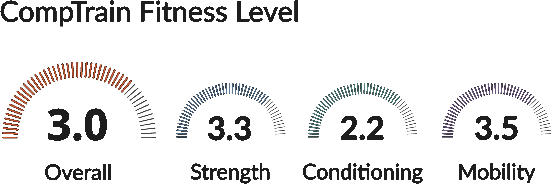
Your Fitness Level is a single number that reflects your overall fitness across Strength, Conditioning, and Mobility. It's calculated as the average of your three tenet scores, each of which carries equal weight. This means neglecting any one area will limit your overall level — which is intentional. Complete fitness requires balance.
Levels are expressed to one decimal place — a 2.1 just entered Intermediate territory, while a 2.9 is on the cusp of Advanced. That granularity matters for tracking progress and setting goals.
Why Strength, Conditioning, and Mobility — and why do all three matter?
Strength is the ability to produce force against resistance. It's foundational — it protects joints, enables daily function, and lowers the relative cost of every movement you perform.
Conditioning governs energy production: how much work you can sustain, how long you can maintain output, and how quickly you recover. It spans everything from aerobic capacity to anaerobic power.
Mobility is your ability to move through full ranges of motion under control. It protects joint health, reduces injury risk, and allows your strength and conditioning to actually express themselves.
When all three are developed together, they compound — and your Fitness Level reflects that. A marathon runner with no upper-body strength is incomplete. A powerlifter who can't run a mile is incomplete. The Assessment measures the whole picture.
The Tests
What tests are included in the Assessment?
The Assessment includes tests across all three tenets, each chosen to measure a distinct and fundamental quality of fitness:
Why not test more movements or include more tests?
Every test in the Assessment was selected because it measures something distinct that no other test in the panel captures. The three strength lifts cover the primary force-production patterns. The three conditioning tests span the energy system spectrum — from aerobic capacity to sustained power output. The mobility tests address the major joints and positions that matter most for functional movement. Adding more tests would create redundancy without improving the accuracy of your overall profile. The goal is a complete picture with the fewest possible data points.
Do I need to complete every test to get a Fitness Level?
You'll receive a score for each test you complete, and your tenet scores update accordingly. The more tests you log, the more accurate and complete your Fitness Level becomes. We encourage completing the full panel over time, but you can start with whatever tests you have access to today and build from there.
What if I don't have access to certain equipment?
Complete the tests you can. Your Fitness Level will be calculated from the data you provide. If you have access to a barbell but not a rower, your Strength scores will be more complete than your Conditioning scores — and that's fine. As you gain access to more equipment, you can log those results and your profile will sharpen. The Assessment is designed to grow with you, not require perfection upfront.
How often should I reassess?
Every 8–12 weeks. This gives your body enough time to adapt to training and produce measurable changes. Retesting too frequently creates noise rather than signal. A shift from Level 2.4 to 2.7 across a training cycle is meaningful, measurable progress — and that kind of change takes consistent work over weeks, not days.
Scoring & Fairness
How is my score calculated?
Your raw test result is compared against scoring tables built for your age group and gender. These tables blend general population data with data from well-trained individuals, then apply a physiological curve that reflects how fitness actually develops. The result is a Fitness Score between 0 and 100.
The curve matters because fitness gains aren't linear. Going from untrained to moderately fit happens relatively quickly. Going from very fit to elite requires significantly more effort for each incremental improvement. The scoring system reflects that — it rewards higher-level performance proportionally to the effort it takes to achieve it. So a jump from Score 40 to 50 represents a different magnitude of work than a jump from 85 to 95.
How does age factor into my score?
Peak physical performance occurs in the 25–29 age range. The system adjusts expectations for every other age group based on well-documented physiological decline rates. A 55-year-old who squats 200 lbs may score the same as a 25-year-old who squats over 300 lbs — because relative to their peers, they're equally strong. Your score reflects how you compare to people your own age, not to a 25-year-old baseline.
Athletes under 25 are evaluated with the understanding that they're near peak physical capacity but may have fewer years of training behind them. The system accounts for this so younger athletes are scored fairly against peers with more training experience.
How are male and female athletes scored?
Males and females are scored against entirely separate population data. Gender-specific adjustments account for biological differences in muscle mass, hormones, and body composition — with the gap being larger in strength-based tests and smaller in aerobic conditioning tests. Mobility has no gender adjustment, because range of motion requirements are universal. These adjustments were validated against real performance data from athletes across the fitness spectrum.
Does body weight affect my strength score?
Yes. The strength scoring uses a method that accounts for body weight behind the scenes, ensuring that athletes of different sizes are evaluated fairly. A 150 lb athlete and a 220 lb athlete can both score well — the system evaluates relative strength, not just absolute load. This prevents the scoring from favoring larger athletes simply because they can move more weight.
Using Your Results
What does the personalized feedback on my results screen mean?
After your assessment, you'll see three sections of coaching tailored to your profile. "Your Assessment" tells you where you stand and identifies any gaps between your tenets. "Your Suggested Training" gives you specific days and training focuses to prioritize based on your results. "Why This Matters" explains the relationship between strength, conditioning, and mobility — and why developing all three together produces higher levels of fitness.
This feedback updates each time your assessment results change, so the guidance stays relevant as you progress.
How does my Fitness Level affect my daily programming?
Your Fitness Level determines how the app scales every workout for you. Programming is written at an advanced level, then automatically adjusts loading, movement complexity, and volume based on where you are. A Beginner sees accessible movements and appropriate loads. An Elite athlete sees heavier loads and more demanding variations. The intent and stimulus of every workout stay the same across all levels — only the expression changes to meet you where you are. You don't have to figure out how to scale. The app does it for you.
What should I focus on to improve?
Your assessment results will point you toward the tenet that needs the most attention. The app's personalized feedback will give you specific guidance, but as a general framework:
If Strength is your opportunity: Focus on Monday, Wednesday, and Friday — your primary lifting days. Don't overlook the accessory work that follows the main lifts. That's where structural support gets built.
If Conditioning is your opportunity: Focus on Tuesday intervals, Thursday threshold work, Saturday conditioning, and Sunday aerobic endurance. Consistent effort across these four days will close the gap fastest.
If Mobility is your opportunity: Prioritize the daily mobility warm-ups, the Tuesday stability progressions, and the mobility flows programmed throughout the week. Even a few extra minutes of focused work on your ankles, hips, and shoulders adds up quickly.
What if my level seems lower than I expected?
The Assessment compares you to the active population for your age and gender — people who train regularly, not the general public. A Level 2.0 (Intermediate) means you're at or above average among people who care about fitness. That's a solid place to be. The level system is also non-linear: progress from 1.0 to 2.0 happens relatively quickly with consistent effort, while every decimal point above 3.0 represents a significant achievement. Trust the process, retest in 8–12 weeks, and let the numbers show you the progress your effort is producing.