

Frequently Asked Questions
Everything you need to know about CompTrain, the Fitness Level system, gym programming, and your subscription.
Getting Started
New to CompTrain? Start here.
Should I download the app or get CompTrain Gym?
Get the app if you're training for yourself. Get CompTrain Gym if you run classes, coach athletes, or need programming for your gym.
Do I need a full gym to start?
No. CompTrain is built to work in different training environments, and workouts include modification options and substitutions when equipment is limited.
I'm a coach, but not a gym owner. Is CompTrain Gym still for me?
Yes. CompTrain explicitly says coaches can use it even if they are not the gym owner.
CompTrain Fitness Level
Everything you need to know about CompTrain Fitness Levels and how they work.
Overview
What are CompTrain Fitness Levels?
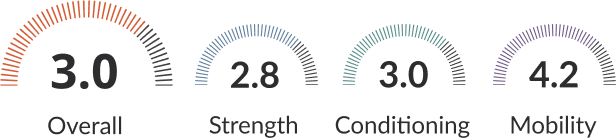
Fitness Levels are built on a series of tests that measure your fitness across three tenets: Strength, Conditioning, and Mobility. Your results produce a Fitness Level from 1.0 to 4.9 that tells you where you stand relative to other active people your age and gender. It gives real context for what your fitness looks like across the board.
What does my Fitness Level mean?
Your Fitness Level is a single number that reflects your overall fitness across Strength, Conditioning, and Mobility. It's the average of your three tenet scores, each weighted equally.
Levels are expressed to one decimal place — a 2.1 just entered Intermediate territory, while a 2.9 is on the cusp of Advanced. That granularity matters for tracking progress and setting goals.
Why Strength, Conditioning, and Mobility, and why do all three matter?
Strength is the ability to produce force against resistance. It protects joints, enables daily function, and lowers the relative cost of every movement you perform.
Conditioning governs energy production: how much work you can sustain, how long you can maintain output, and how quickly you recover. It covers everything from aerobic capacity to anaerobic power.
Mobility is your ability to move through full ranges of motion under control. It protects joint health, reduces injury risk, and allows your strength and conditioning to actually show up.
When all three are developed together, they compound, and your Fitness Level reflects that.
How It Works
What tests make up my Fitness Level?
Do I need to complete every test to get a Fitness Level?
No. You'll receive a score for each test you complete, and your tenet scores update accordingly. The more tests you log, the more accurate and complete your Fitness Level becomes. We highly encourage completing the full panel over time, but you can start with whatever tests you have access to today and build from there.
How often should I retest?
It depends on what you're retesting. Mobility and Conditioning: every 4 to 8 weeks. Strength: every 8 to 12 weeks. That gives your body enough time to adapt to training and produce measurable changes.
Scoring & Fairness
How is my score calculated?
Your raw test result is compared against scoring tables built for your age group and gender. These tables blend general population data with data from well-trained individuals, then apply a physiological curve that reflects how fitness actually develops. The result is a Fitness Score between 0 and 100.
The curve matters because fitness gains aren't linear. Going from untrained to moderately fit happens relatively quickly. Going from very fit to elite takes significantly more effort for each incremental improvement. The scoring reflects that. It rewards higher-level performance in proportion to how hard it is to get there. A jump from Score 40 to 50 is a different magnitude of work than a jump from 85 to 95.
How does age factor into my score?
Peak physical performance occurs in the 25 to 29 age range. The system adjusts expectations for every other age group based on well-documented physiological decline rates. A 55-year-old who squats 200 lbs may score the same as a 25-year-old who squats over 300 lbs, because relative to their peers, they're equally strong. Your score reflects how you compare to people your own age, not to a 25-year-old baseline.
Athletes under 25 are evaluated with the understanding that they're near peak physical capacity but may have fewer years of training behind them. The system accounts for this so younger athletes are scored fairly against peers with more training experience.
How are male and female athletes scored?
Males and females are scored against entirely separate population data. Gender-specific adjustments account for biological differences in muscle mass, hormones, and body composition. The gap is larger in strength-based tests and smaller in aerobic conditioning tests. Mobility has no gender adjustment because range-of-motion requirements are universal. These adjustments were validated against real performance data from athletes across the fitness spectrum.
Does body weight affect my strength score?
Yes. The strength scoring accounts for body weight so that athletes of different sizes are evaluated fairly. A 150 lb athlete and a 220 lb athlete can both score well. The system evaluates relative strength, not just absolute strength, so it doesn't favor larger athletes simply because they can move more weight.
Using Your Results
What do my results mean?
After you complete your tests, you'll receive a level for each of the three tenets of fitness (Strength, Conditioning, and Mobility) and your overall CompTrain Fitness Level. Scores are compared to your age and sex demographic and adjusted for your body weight. Below your Fitness Level, you'll find coaching insights and training recommendations based on your profile, helping you prioritize and get the most out of your training.
What should I focus on to improve?
Your results will point you toward the area(s) that need the most attention. The app's personalized feedback will give you specific guidance, but here's a general framework:
If Strength is your weakest area: Focus on Monday, Wednesday, and Friday, your primary lifting days. Don't overlook the accessory work that follows the main lifts. That's where structural support gets built.
If Conditioning is your weakest area: Focus on Tuesday intervals, Thursday threshold work, Saturday conditioning, and Sunday aerobic endurance.
If Mobility is your weakest area: Prioritize the daily mobility warm-ups, the Tuesday stability progressions, and the mobility flows programmed throughout the week. Even a few extra minutes of focused work on your ankles, hips, and shoulders adds up quickly.
What if my level seems lower than I expected?
Your Fitness Level compares you to the active population for your age and gender. You're compared to people who train regularly, not the general public. A Level 2.0 (Intermediate) means you're at or above average among people who care about fitness. That's a solid place to be. The level system is also non-linear. Progress from 1.0 to 2.0 happens relatively quickly with consistent effort, while every decimal point above 3.0 represents a serious achievement. Trust the process, retest often, and let the numbers show you the progress your effort is producing.
CompTrain Gym
Programming and coaching tools for gym owners and coaches.
What is CompTrain Gym?
CompTrain Gym is for gym owners and coaches who want complete class programming, detailed lesson plans, coach development content, and scaling guidance — not just a daily workout.
What's included?
You get 7 days of programming each week, coaching resources, scaling options, web access through CompTrain, plus integrations with SugarWOD, PushPress, BTWB, and StreamFit.
How much does CompTrain Gym cost?
CompTrain Gym starts with a 14-day free trial, then costs $99.99/month, or $83.33/month when billed annually.
Training & Philosophy
How CompTrain designs its training.
What kind of training does CompTrain deliver?
CompTrain is built around complete training: strength, conditioning, and mobility developed together so athletes are prepared for life, adversity, and long-term progress.
How is the program structured?
The gym program runs 7 days per week, including a team workout on Saturday and a run-focused Sunday, with strength cycles layered into a concurrent conditioning approach.
What makes the philosophy different?
The goal is to build strength, endurance, and capacity together while avoiding burnout, so training stays effective, repeatable, and sustainable for the majority of members.
Billing & Access
Pricing, subscriptions, and platform access.
Does CompTrain Gym include the CompTrain app?
No. A CompTrain Gym subscription does not include paid access to the CompTrain app.
What does the app cost for individuals?
The current individual app pricing is $19.99/month for Basic and $39.99/month for Pro, with annual options also available.
Can I cancel anytime?
Yes. CompTrain Gym says you can cancel your subscription or free trial at any time.