

The Performance Pyramid

The Performance Pyramid | A Better Way to Pursue Greatness
This article was originally published on The Better Way
So many people set daring, exciting goals for themselves and within a week completely abandon them.
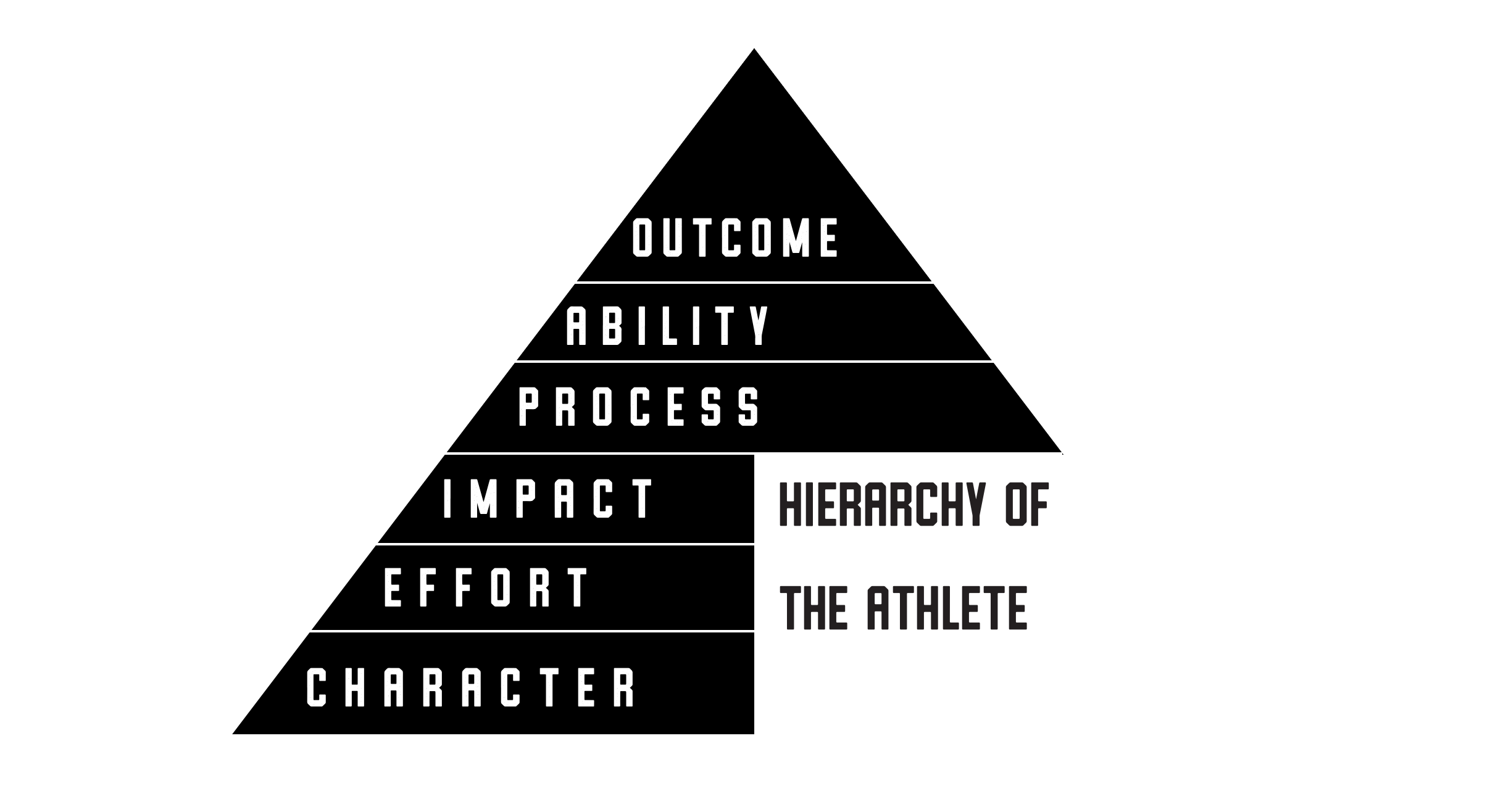
Most of the time. I don’t think the problem is discipline or motivation. I think the problem is that we keep starting at the top of the pyramid when we should be starting at the bottom.
An important caveat here…this is written in the context of athletic pursuits, but can (and should) really be applied to any project, process, or…well…life in general.
In the pursuit of greatness, success goes way beyond winning races or chasing PRs. The real game is quite a bit more meaningful than that.
The real challenge is who you’re becoming, how you show up for others, and whether your life is actually aligned with what you say matters. That’s where the Performance Pyramid comes in and why it might be the most useful framework you pick up this year.
Most people obsess over the top of the pyramid (ability and outcome) which is how strong, how fast, how fit, how many wins. But the athletes who last, the ones who lead and impact and keep growing long after the race stops, they build from the bottom up…details on that below:
I’ve experienced this in a significant way in my own life. Good things I pursued became my entire personality. Training stopped being something that improved my life and became something that replaced it. The outcome became the obsession, and the obsession hollowed out everything beneath it. It took years to understand that the foundation matters more than the finish line.
I want to suggest a different approach. Instead of asking “What do I want to accomplish?” start with “Who do I want to become?”
Let’s walk through each layer, and I’ll give you some simple, functional ways to train them, starting this week.
Character: The Bedrock of Excellence
Character is the foundation. It’s who you are when the scoreboard is off and nobody’s watching. It shows up in how you treat the last place finisher, whether you own your mistakes, and how you respond when things don’t go your way.
Athletes with strong character show humility in victory and grace in defeat. They play hard and they play fair. This isn’t soft stuff. This is the bedrock that everything else stands on. And if you want 2026 to be different, my contention is that this is where it starts.
How to train character this week: Own one thing fast. When you mess up, say “That’s on me. I’ll fix it.” No excuses, no spin.
Do an unseen rep, something hard that no one will know about: extra recovery work, cleaning the gym floor, encouraging a teammate privately.
Set one non-negotiable for yourself, something like “I don’t talk negatively about teammates or opponents. Ever.” Make that your January commitment.
Effort: The Fuel for Achievement
Effort is your willingness to show up when it’s not fun, not glamorous, and not convenient. It’s finishing the interval when your lungs are on fire. Staying engaged even after you realize you’re not going to win, hit your goal, etc... Choosing the harder right over the easier wrong.
We should approach effort like a video game. When you die in a video game, you don’t typically respond with “I suck at video games, I don’t wanna do this. I give up.” You just respawn and go again, but now with more information. And like in a video game, this process can and should be enjoyable, not dreadful. Effort is how you vote for who you’re becoming. Every day in January is a vote for the kind of year you’ll have because it’s a vote for the kind of person you’re going to be.
How to train effort this week:
Pick one “hard thing” per session. It might be the heaviest set, the last round, or the last 400m.
Rate your effort honestly on a 1-10 scale after each session and jot a one-sentence reflection: “Today was a 7/10 because I checked out early.” Adjust tomorrow.
Practice “no hiding”…don’t coast in the back, don’t sandbag the warm-up, don’t excuse yourself out of the version of training that will help you grow.
Impact: Beyond the Game
Impact is what your effort and character do to the people around you. Impact is what happens BECAUSE of what you do. This is where you move from “How did I perform?” to “What did my effort and presence change for others?” Impact shows up when you encourage the nervous newbie, celebrate someone else’s PR louder than your own, or bring calm energy when everyone else is frantic.
You don’t need a platform to have impact, you just need to be intentional. What if your resolution for 2026 wasn’t about what you’d achieve, but about how you’d make others feel in your presence?
How to train impact this week:
Encourage one person per session. Not with a generic “good job,” but something specific: “I saw how you finished that last set. That was awesome”
Go first. First to start cleaning up, first to listen, first to say “my bad.” Leadership is often just going first.
Ask one real question: “How are you actually doing?” Then listen. Don’t rush to respond. Just be present. Make January the month you become someone people are glad to see walk through the door.
Process: The Path to Mastery
Process is the daily, often boring, system of how you train and live. Most people treat training like an event. High-performers treat it like a ritual. Process means clear goals, simple plans, showing up whether you feel like it or not, and letting the system carry you when motivation doesn’t.
Athletes who love the process don’t live and die by one session, don’t freak out over one bad day, and trust that reps compound. This is what makes the difference between a resolution that lasts two weeks and a rhythm that carries you through the whole year, and the rest of your life.
How to train process this week:
Plan your week before it starts. Write down your training days, focus areas, and non-negotiables.
Set one or two quality focused process goals for January, something like “Hit all my warm-up sets with full focus” or “No missed sleep under 6.5 hours this week.”
Do a five-minute weekly review on Sunday: What worked? What didn’t? What’s one small adjustment for next week? Do this every Sunday in January, and you’ll enter February with momentum.
Ability: Harnessing Natural Talent
Ability matters. Genetics are real. Some people are taller, faster, more explosive. But raw ability without character, effort, impact, and process is fragile. The goal isn’t just to have talent, it’s to steward it, to unlock it’s potential.
That looks like addressing weaknesses instead of hiding them, building the unsexy basics like building your aerobic base with long, slow sessions. Working on your mobility. Or maybe even taking a full day off when your performative mentality sees that as a “sin.” I’ve seen athletes with remarkable gifts flame out because they never learned to tend to what was underneath. Talent without stewardship becomes a liability. The new year is a good time to ask yourself: What am I avoiding? Where have I been coasting?
How to train ability this week:
Pick one weakness block—10 to 20 minutes, two to three times this week, on something you avoid: mobility, aerobic base, nutrition...dial one of these in. Ask a coach for one honest note: “What’s one ability constraint that holds me back?” Then build a tiny plan around that.
Outcome: Achieving Excellence
Outcome is where most people start. It’s the scoreboard, the PR, the ranking, the podium. Outcomes matter for sure. They’re feedback, they’re data, they’re milestones to celebrate. But they’re not the whole story. And they’re a terrible place to begin a new year.
The right way to see outcome is as a report card on your current process, not a verdict on your worth. As a checkpoint, not your identity. When you build the other layers well, outcomes become more predictable over time, less emotional when they go badly, and less intoxicating when they go well. Confidence untethered from character becomes arrogance. And ambition without grounding becomes a kind of hunger that feeds on itself…always chasing, never arriving."
How to train your relationship with outcomes this week:
Set one clear performance target for January. A time trial, lift, or benchmark workout. Write it down and go after it. Afterward, debrief with ruthless honesty. Ask yourself: What did this reveal about my character, effort, process, and ability? What’s one thing I’ll keep, and one thing I’ll change? When you talk about it with others, mention the effort, lessons, and people before the numbers. Let the outcome inform you, not define you.
A Simple Weekly Check-In for January
Once a week, take five minutes to run through these questions. They’re not meant to be exhaustive, just enough to keep you honest with yourself. Do this every Sunday in January and see what shifts.
On character: Did I act like the kind of person I want to be? Where did I cut corners, hide, or shift blame?
On effort: How many sessions this week would I be proud to replay? Where did I mentally quit before the session was over?
On impact: Did anyone leave better because I was there? Who did I encourage, support, or serve?
On process: Did I follow my plan? What broke down? Was it schedule, sleep, or something else?
On ability: What capacity or quality improved even slightly? What weakness did I actually address?
On outcome: What did my results reveal about my current approach? What’s one adjustment I can make next week?
Major in the Majors
If you remember nothing else as you step into 2026, remember this:
Character, effort, impact, and process…these are the majors.
Ability and outcome are important, but they’re the minors. Build the bottom of the pyramid relentlessly, and the top will take care of itself far more often than not.
You don’t control every outcome. You absolutely control the kind of person you are becoming, the effort you bring, the impact you make, and the process you commit to.
Here’s the beautiful thing about this approach. When sport (or some particular event) ends, as it always does, those foundations don’t disappear. They become the way you lead your family, build your career, show up for your community, and live your actual life.
Don’t just set goals. Build foundations. Major in the majors. Let your performance be the proof.
Always Forward, my friends.
-JP


Complete Training


