

A Simple Guide to VO₂ Max

A Simple Guide to VO₂ Max
What is VO₂ Max?
VO₂ max is the maximum amount of oxygen your body can use during intense exercise. It's measured in milliliters of oxygen per kilogram of body weight per minute (ml/kg/min). Said more simply, the more oxygen your body can utilize compared to your size, the more aerobically efficient you are.
Think of it like this: If you have a large engine, you can use more fuel, allowing you to move faster and for longer before losing steam. This is what we mean by “aerobic capacity.”
Why it Matters
For Performance
If you do anything that requires sustained effort—running, rowing, HYROX, a long workout—your VO₂ max sets the ceiling of your performance potential. A higher VO₂ max means you can hold a faster pace longer before hitting “the wall.”
For Longevity
A 2018 study from the Cleveland Clinic followed over 122,000 adults for nearly a decade. The findings were striking:
- People in the elite fitness group (top ~2%) had an 80% lower mortality risk compared to those in the low fitness group
- The low fitness group had a 5x higher risk of death than the elite group
- Every increase in VO₂ max of roughly 3.5 ml/kg/min lowered all-cause mortality by 10-15%
To put that in perspective: the difference between low and elite fitness was far greater than the mortality risk from smoking, diabetes, or hypertension.
Higher VO₂ max doesn't just mean you perform better. It means you're more likely to live longer and stay healthy.
The reason is simple: VO₂ max improvement drives mitochondrial health (the energy-generating parts of your cells), which improves metabolism, reduces inflammation, and lowers your risk of diseases that shorten lifespan.
Where Do You Stand?
Use these benchmarks to see where your VO₂ max falls. Values are in ml O₂/kg/min.
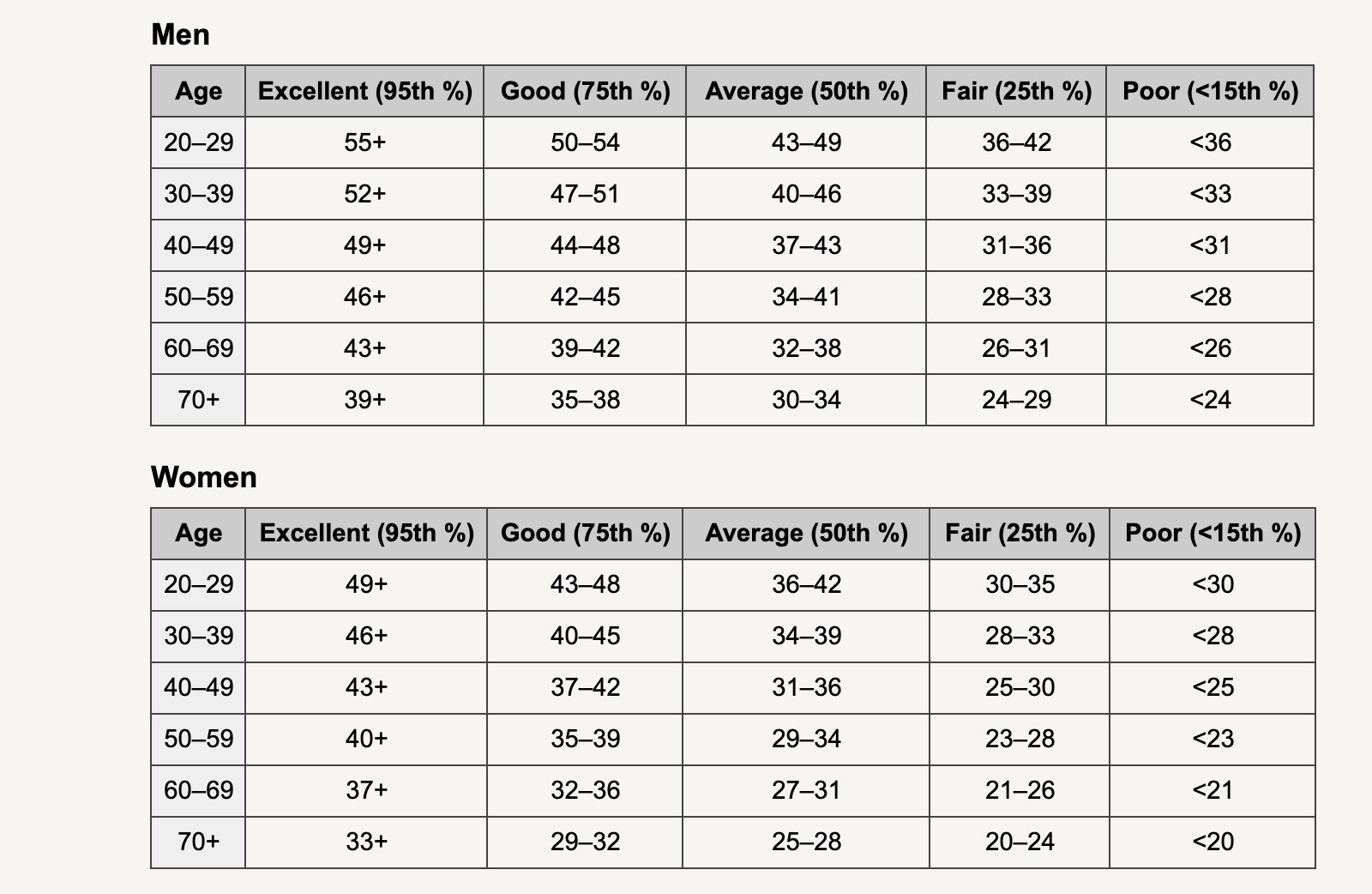
Excellent: Top 5%. Elite endurance capacity.
Good: Well-trained. Strong protection against chronic disease.
Average: Typical for healthy adults. Room to improve.
Fair: Below optimal. Regular aerobic training should be a priority.
Poor: Elevated disease risk. Start with low-intensity work and build gradually.
How to Test Your VO₂ Max
Lab Test
The most accurate method uses direct gas analysis on a treadmill or bike. Essentially, you breathe into a tube while exercising, which measures the gases you inhale and exhale as exercise intensity rises. Many universities and sports performance centers offer this.
Field Tests
- Cooper 12-Minute Run: Run as far as you can in 12 minutes. Plug the distance into an online calculator to estimate VO₂ max.
- 1.5-Mile Run: Time yourself running 1.5 miles as fast as possible. Use an online calculator for the estimate.
- 2k Row Time Trial: On a rowing erg machine, row 2,000 meters as fast as possible (about 6-10 minutes for most people). Use an online calculator for the estimate.
Wearables
Garmin, Apple Watch, and Whoop estimate VO₂ max based on heart rate data during runs. These aren't as accurate as lab tests, but they're useful for tracking trends over time.
How to Improve VO₂ Max
After training thousands of athletes, here's what we've seen work:
1. Zone 2 Endurance: Improve Your Aerobic Base
- Intensity: 60-70% of max heart rate. You should be able to hold a conversation.
- Duration: 40-90 minutes
- Frequency: 1-3 times per week (prioritize longer sessions—one 90-minute session is better than two 45-minute sessions if you're also doing higher-intensity work)
- Why it works: Builds mitochondria (your cells' power plants for energy production) and improves fat utilization for energy. This is your aerobic foundation.
2. VO₂ Max Intervals: Increase Your Aerobic Ceiling
- Intensity: 85-95% of max heart rate. This should feel like an 8-9 out of 10 effort—very hard, but sustainable for the full interval.
- Duration: 3-5 minute intervals with roughly equal rest
- Frequency: 1-2 times per week
- Why it works: Pushes your cardiovascular system to its limit, forcing adaptations in cardiac output and oxygen delivery.
- Example: 5 rounds of 4 minutes hard running, rowing, biking, or skiing, with 4 minutes rest between rounds
3. Threshold Work: Improve Your Aerobic Efficiency
- Intensity: 80-90% of max heart rate. Hard but sustainable.
- Duration: 10-20 minutes continuous
- Frequency: 1-2 times per week
- Why it works: Improves your body's ability to clear lactate and sustain a high effort.
4. Anaerobic Intervals: Improve Your Upper Limits
- Intensity: 95-100% of max heart rate. Near-maximal to maximal efforts.
- Duration: 30 seconds to 2 minutes with incomplete rest (30-90 seconds recovery)
- Frequency: 1-2 times per month
- Why it works: Repeated high-intensity efforts with short recovery create cumulative oxygen debt, forcing your aerobic system to adapt. This complements longer VO₂ max intervals by training your body to recover quickly and sustain high output under metabolic stress.
5. Mixed-Modal Work: Apply It in the Real World
- Why it matters: The more muscles you engage, the higher your oxygen demand. Mixed-modal training teaches your body to sustain high aerobic output while managing complex movements, coordination demands, and fatigue across different muscle groups.
- Example: Workouts combining running with thrusters, box jumps, or burpees teach your body to apply its aerobic capacity across varied demands.
- The benefit: Life doesn't ask you to run on a treadmill. It asks you to carry things, move quickly under load, and perform when fatigued. You're not just fit in a lab. You're capable in real life.
Which Movements Work Best?
For Pure VO₂ Max Development
The best exercises are:
- Rhythmic and continuous (e.g., running, rowing, biking, skiing)
- Involve large muscle groups
- Sustainable for 3-5 minutes at near-max effort
Running typically produces some of the highest VO₂ max scores due to the large muscles involved and because it's weight-bearing, which places a higher demand on your cardiovascular system.
For Functional Capacity
Loaded compound movements (e.g., thrusters, deadlifts, lunges, power cleans) and bodyweight movements (e.g., burpees, box jumps, jumping lunges) are essential. They:
- Preserve muscle mass (a key predictor of longevity)
- Improve movement economy (you use less oxygen for the same work)
- Improve total body oxygen utilization and lactate clearance
- Train you to apply your aerobic capacity under complex, real-world demands
The Best Approach
Combine cardio movements (to maximize aerobic demand) with loaded and bodyweight movements (to apply that capacity under real-world conditions).
What to Expect
Beginners: Can improve VO₂ max by 10-20% in 3-6 months with consistent training.
Intermediate athletes: Expect 5-10% gains over 6-12 months.
Advanced athletes: Improvements slow down. At this point, focus on efficiency, economy, and threshold work.
About 50% of your VO₂ max potential is genetic, but that still leaves a lot of room to improve. The most important factor is consistency over years, as opposed to short periods of focused efforts that die off.
The Bottom Line
Your VO₂ max is one of the best indicators of how long and how well you'll live. It's trainable, measurable, and worth paying attention to.
Improve it through a mix of zone 2 work, high-intensity intervals, threshold training, and anaerobic capacity work. Test it occasionally to track progress. And remember: the goal isn't just a higher number (though that is good)—it's about having the capacity to show up, perform, and stay capable for decades.


Complete Training


