

Train For More: Why Well-Rounded Training Matters
Train For More: Why Well-Rounded Training Matters
Why I Think Most People Should Train to Be Well-Rounded
I've spent the last 15 years training at the highest levels of fitness. And the longer I'm in this, the more convinced I become that most of us could be training in a better way.
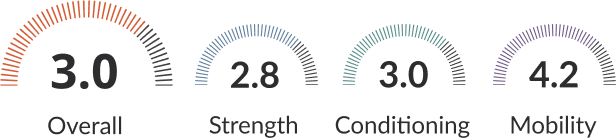
I think most people should train to be well-rounded. And I don't mean that in a vague "do a little bit of everything" kind of way. I mean deliberately building balanced capacity across strength, conditioning, and mobility.
Here's why.
Your Body Doesn't Naturally Specialize
The human body doesn't organize itself into single modalities, training splits, or workout categories. It's an integrated system that needs to produce force, sustain effort, and move through ranges of motion—often all at the same time.
Strength without conditioning means you're powerful for about 10 seconds, then you're gassed. Conditioning without strength means you can go forever, but you can't do much when you come against resistance. Mobility without either means you're flexible, but fragile.
These aren't theoretical limitations. They're real constraints that show up when life demands something your training hasn't prepared you for.
Life’s Demands Are Unpredictable
Unless you're a professional athlete, most of what you need your body to do is unpredictable.
You need to sprint after your dog. Lift something heavy off a high shelf. Carry groceries. Play with your kids without tweaking your back. Help a friend move. React quickly when someone stumbles.
None of those situations cares whether you can deadlift 500 pounds or run a sub-3 marathon. They care whether you have enough strength, enough conditioning, and enough mobility to handle what's in front of you without breaking down.
When you train to be well-rounded, you're not training to be the best at anything. You're training to be capable of everything that might be asked of you. Professional athletes have different demands; for the majority, we want to be ready for as much as life can ask of us.
Balanced Training Makes You Harder to Break
Here's something I've noticed over years of training and coaching: people who specialize break down more.
Endurance athletes develop overuse injuries because they lack the durability that strength gives them. Lifters break down under high training volumes because their conditioning can't keep up with what their muscles can put out. Athletes who are only flexible and mobile get injured in their deepest ranges because they don't have the stability to control those positions under load.
When we train strength, conditioning, and mobility together, they protect each other. We become harder to break. Not because we’ve become indestructible, but because we don't have glaring weak points waiting to fail.
Well-Rounded Training Buys You Time
Our bodies are going to decline. I’m not trying to be pessimistic, quite the contrary. I’m just acknowledging it's biology. And that means how it declines is largely up to us.
If we only train one quality, we’re banking everything on that one thing holding up over the long term. When it starts to go, and it will, we’re left with very little.
But if we build balanced capacity across multiple domains, we give ourselves options. When running gets harder, we still have our strength. When our max deadlift drops, we still have our conditioning. When joints start getting stiff, we’ve developed good range of motion to keep us mobile for longer.
Well-rounded training doesn't prevent aging, but it slows its rate, giving us more time with years full of vitality. And more vitality means we keep moving, keep playing, keep showing up.
Capability Is a Form of Generosity
I think about this a lot as a husband and father. My body isn't just mine. It's a tool I use to serve the people I love.
Being capable isn't about fueling my ego. It's about creating a life I can serve with. A well-rounded body doesn't just make our lives better. It makes us better for the people around us. We’re not the person who has to sit out. We’re not liabilities; we’ve become assets.
So What Does This Actually Mean?
I'm not saying you need to do CompTrain or train like me (though it would help).
I do think most people would benefit from asking themselves: Am I actually building balanced capacity, or am I ignoring certain areas, hoping the rest takes care of itself?
If we can't sustain moderate effort for 20 minutes, we need more conditioning. If we can't handle load in basic positions, we need more strength. If we can't touch our toes or sit in a deep squat, we need more mobility.
We don't need to be elite at any of them. But we do need a foundation in all of them. And once you have that foundation, the goal isn't to maintain, it's to keep enlarging it. Because the more capable we are, the more life we can live.
A Final Thought
I know don't have this all figured out, but I’ve devoted the last decade of my life to being the most well-rounded I could be as a professional athlete, and that’s given me a lot of freedoms at 35 that are really easy to take for granted.
If we want vitality later in life, we have to start working for it now. And if there is one thing I know from my time as a professional athlete, that process takes what it takes. No more, no less.
And if the process is worth doing, it's worth doing completely.
- Cole Sager


Complete Training


